
Insights · websites ·
Websites for Slovenian SMBs in 2026: WordPress, Astro, or custom — and what it actually costs
Websites for Slovenian SMBs in 2026: WordPress ~70%, Astro ~20%, custom ~10% — the decision matrix, real build prices from €600 to €15k+, and the hidden yearly costs nobody quotes upfront.
TL;DR
- WordPress ~70% of the time, Astro ~20%, custom ~10% — pick based on who edits the site for the next five years, not what the developer prefers.
- Typical Slovenian market launch prices: single-page from €600, 5-page WordPress from €1,200, WooCommerce from €2,800, booking app €5,000–15,000+.
- A €1,500 build costs €600–900/year to keep alive properly. “Just €5/month forever” means unpatched, unbacked-up, or the developer’s about to disappear.
- Content readiness moves timelines more than anything else — client with content on day one ships in 7 days; fragmented content takes 5 weeks.
A small-business owner in Slovenia asked me last month whether she even needed a real website anymore. Her customers found her through Instagram and Google Maps. She had a Linktree, a booking link, and a phone number. “Is a proper site still worth the money?”
The honest answer is: yes, but only if you treat it as infrastructure, not as a brochure. In 2026 a website is the one piece of digital presence you control end-to-end. Instagram can ban you, Facebook can change its algorithm, Google Maps can demote your listing. Your own site at your own domain is the only asset that survives all of that — and the only place where an AI search engine can read your full story and recommend you.
This guide is for SMBs in Slovenia who are either getting their first real site or rebuilding one that’s quietly costing them customers. It’s stack-agnostic, prices in euros, and tries to answer the questions developers usually duck.
Why a website still matters for an SMB in 2026
Three composited cases from this year — recurring patterns from across our client base, identifying details anonymised:
- A dental practice in Gorenjska with a 2014 site that didn’t open booking on mobile. Half their inquiries used to come through Facebook DMs. After a rebuild with a real booking form, GDPR-compliant cookie consent, and a basic Google Business Profile sync, organic inquiries doubled in three months. The practice didn’t grow — the leakage stopped.
- A small family campsite that had no site at all, only a Booking.com listing taking a 15% cut. A four-page site with their own photos, prices, and a direct WhatsApp button reduced Booking.com dependency from 90% of nights to about 55%.
- A regional NGO with a site no one on the team could edit. Every typo cost €40 in developer time. A WordPress rebuild gave them a CMS the volunteers could update, and the developer bill on the site dropped to zero outside of emergencies.
None of these are “marketing wins”. They’re infrastructure wins. The site stopped leaking money.
WordPress, Astro, or custom?
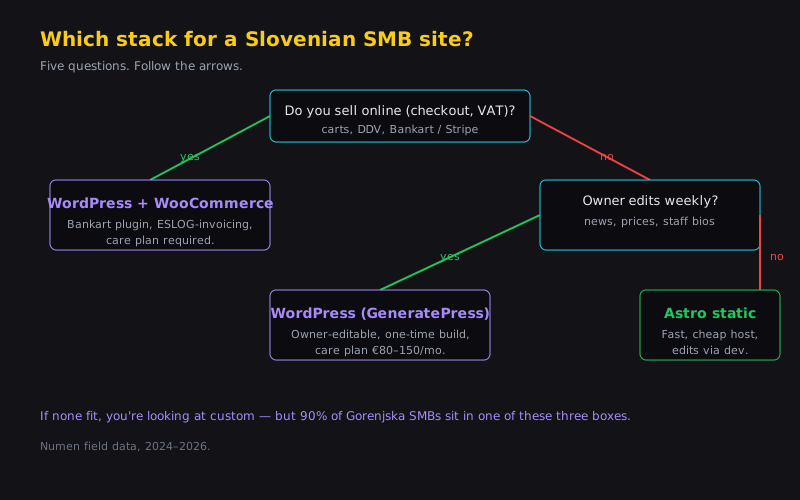
There is no universally right answer. The right answer depends on who edits the site, how often, and what it has to do. Here is the decision matrix I use:
| Criterion | WordPress | Astro / static | Custom build |
|---|---|---|---|
| Time to launch | 1–3 weeks | 1–2 weeks | 4–12 weeks |
| Hosting cost / month | €5–25 | €0–5 | €25–200+ |
| Edit by non-developer | Easy (CMS in browser) | Hard (needs Markdown + deploy) | Depends on what was built |
| Page load on mobile | 1.5–4s with care | 0.4–1.2s | Whatever you engineer |
| Plugin ecosystem | Massive (forms, SEO, GDPR) | Smaller, growing | You build it |
| Best for | Content-heavy, multilingual, shop | Marketing, portfolio, brochure | Booking systems, web apps, custom flows |
In practice, ~70% of SMB sites I build are WordPress, ~20% Astro or static, ~10% something custom. WordPress wins when the owner wants to add a blog post, swap a photo, or edit a price without asking a developer. Astro wins when the site is essentially a high-quality digital brochure and edits are rare. Custom wins when the site is doing real work — bookings, calculators, members-only content, a B2B portal.
Don’t pick based on what your developer prefers. Pick based on who is going to live with the site for the next five years. That’s the same lens we use across every website build — and it’s why the care plan is priced separately from the launch.
Want to see the exact template before you commit? We ship a full, on-brand mockup site on your own domain first — real content, real design, real speed. Only when you approve it do we invoice the build. No decks, no discovery-call gauntlet. Browse recent work to see what the shipped versions look like.
The hidden costs nobody mentions
The build is the small part. The site is the rest of your life. Plan for:
- Domain: €15–40 per year for a
.siTLD, slightly less for.com. - Hosting: €5–25/month for shared WordPress hosting in the EU, €0–5 for static, €25–200+ for managed VPS or platform-as-a-service.
- SSL certificate: free via Let’s Encrypt almost everywhere now. If a host is still charging for SSL, leave that host.
- GDPR cookie banner: free libraries exist; if you use Google Analytics or Meta Pixel, you legally need consent before firing them. Done wrong this is a real Information Commissioner risk.
- Backups: €0–10/month if your host includes them, €5–15/month standalone.
- Security plugin / WAF: €0–60/year for WordPress (Wordfence, etc.).
- Theme + plugin licenses: WordPress premium themes €40–80/year, premium plugins €30–200/year each. Most sites use 2–5 paid plugins.
- Updates and patches: nobody quotes this honestly. A WordPress site abandoned for 18 months will get hacked. Plan €30–80/month for someone to keep it patched.
- Content: if the developer writes your copy, that’s a real cost — €40–80 per page is normal. Photos: €200–500 for a half-day shoot, far less if you have a decent phone and a sunny afternoon.
A site that costs €1,500 to build can easily cost €600–900/year to keep alive properly. Anyone telling you “just €5/month forever” is either not patching it, not backing it up, or about to disappear.
What a real SMB website costs in 2026
Typical ranges on the Slovenian market this year, for context — Numen’s own fixed packages are on the website page. Prices vary with content readiness, language count, and how custom the design is:
- Single-page launch site (one long page, contact form, basic SEO): from €600.
- Standard 5-page WordPress (home, about, services, contact, one content section, GDPR + analytics + SEO basics): from €1,200.
- Multilingual 5–10 page site (SL + EN, sometimes ES or DE): from €1,800.
- WooCommerce store (product catalogue, payment gateway, shipping, tax rules): from €2,800.
- Booking platform or web app (calendars, accounts, payment, custom flows): €5,000–15,000+ depending on scope.
These are launch costs. Add 10–25% of the build for the first year of care if you want it run properly. After year one, it’s typically €30–80/month for hosting + care, and small content edits included.
Hosting, care, and what “vzdrževanje” actually means
When a developer says they’ll handle “vzdrževanje” (maintenance), ask them to write down exactly what’s in it. A real care plan covers:
- Managed hosting in the EU (Schrems-II-friendly), with HTTPS auto-renewed.
- Daily backups stored off-host, with a tested restore process — not just “backups exist”.
- 24/7 uptime monitoring with email or SMS alert when the site goes down.
- Security patches applied within 24–48 hours of release, tested in staging before they hit production.
- Plugin and CMS updates done monthly, with a manual smoke test after.
- Small content edits (typos, photo swaps, a new staff member) included — say, up to 1–2 hours/month.
- Response time when something breaks — 4 working hours is reasonable for an SMB, 1 hour for a shop on Black Friday.
If the quote doesn’t specify all of the above in writing, you don’t have a care plan, you have a billing arrangement.
How long does it take, and what fits “1–2 weeks”
We promise 1–2 weeks for a clean marketing site. That’s honest only because we say no to scope that doesn’t fit. Specifically:
- 1–2 weeks works for: one-page or 3–5 page WordPress sites with content the client already has, one language, a standard template adapted to their brand, contact form + Google Maps + GDPR consent.
- 3–4 weeks for: 5–10 pages with copy work, multilingual, a non-trivial design pass, a few WooCommerce products.
- 6–10 weeks for: full e-commerce stores with custom shipping/tax rules, booking systems, member areas, custom data integrations.
The single biggest factor is content. A client who hands over text, photos, and final logo on day one ships in 7 working days. A client whose content arrives in fragments over a month ships in five weeks. There is no developer trick that fixes this — code is the easy part.

Common mistakes Slovenian SMBs make
A short list of things I’ve seen go wrong, in roughly the order they show up:
- Multilingual done as duplicate sites. You don’t need two domains for SL and EN. WPML or Polylang on WordPress, or a clean i18n setup on a static site, gives you one domain and one set of analytics with proper
hreflangtags. Search engines reward this. - GDPR consent done wrong. Cookies for Google Analytics or Meta Pixel must fire only after explicit consent. A banner that says “by using this site you accept cookies” while already firing trackers is a real legal risk.
- No real Google Business Profile. For most local SMBs, the Google Business Profile drives more traffic than the website itself. Set it up, claim it, add hours, add photos, ask happy customers for reviews. It’s free and it works.
- Mobile speed ignored. More than 70% of SMB traffic in Slovenia is mobile. If your site takes 5 seconds to render on a phone, you’re losing half your visitors before they see anything. Test on
PageSpeed Insightsand aim for an LCP below 2.5 seconds. - No analytics or hostile analytics. Either no measurement at all (you have no idea what’s working) or a copy-paste Google Analytics that breaks GDPR. The fix: Plausible, Umami, or properly consented GA4.
- No SEO basics. Page titles that don’t describe the page. Missing meta descriptions. Headings that don’t match the content. None of this is hard, but it has to be deliberate.
FAQ
Is a cheap WordPress site as good as an expensive one? The hosting and the plugins are identical. What you’re paying for is design judgment, content discipline, GDPR compliance, SEO setup, and someone who will pick up the phone in six months. A €400 site and a €1,800 site can use the same theme — the €1,800 site doesn’t go down on its own.
WordPress or custom — what should I pick? If you want to edit the site yourself and the site is mostly content (pages, blog posts, products), WordPress is almost always the right answer. Pick custom only when the site has to do something WordPress can’t do cleanly — complex booking, member portals, custom B2B flows.
How long until my site is live? For a focused marketing site with content ready: 5–10 working days. For a full multi-page site with copy and design iteration: 2–4 weeks. For a shop or multilingual: 4–8 weeks. Content readiness moves this number more than anything else.
How much does a multilingual site cost? Roughly 20–35% on top of the single-language build. Most of that cost is translation, not technical work. A proper i18n setup on a clean codebase is half a day of work.
Who owns the site after launch? You. The domain, the hosting account, the source code, the content — all yours, in your name. If your developer keeps any of those in their own name, you are renting your own business. Walk away.
Is hosting included in the build? Sometimes for the first 3–6 months as part of launch. After that it’s a separate monthly cost. Anyone offering “free hosting forever” is either pricing it into year-one build or about to disappear. Both are fine; just know which one.
Can I edit the site myself? On WordPress: yes, easily, after a 30-minute walkthrough. On a static / Astro site: only with developer help, unless you’re comfortable with Markdown and Git. Pick based on how much you want to edit. Most SMBs underestimate this — once they have a CMS, they edit a lot.
Do I need analytics? Yes, but minimal and consented. You need to know which pages get visited and where traffic comes from. You don’t need a heatmap, a session recorder, or a marketing-stack of fifteen scripts. Plausible or Umami for €9/month is enough for 90% of SMBs.
If you’re somewhere in this guide and not sure which path fits, that’s normal. At Numen we do exactly this work for Slovenian SMBs — first call is free, written quote, no follow-up gauntlet. If your project skews toward a shop rather than a marketing site, jump to WooCommerce in Slovenia; if hosting jurisdiction matters to you, see EU-hosted vs US-hosted.


