
Insights · e-commerce ·
WooCommerce in Slovenia: what it actually costs to sell online in 2026
A real anatomy of a Slovenian WooCommerce store — why it beats Shopify, what you pay monthly, how to handle VAT, payments, Pošta Slovenije and multilingual, and where most projects quietly fail.
TL;DR
- For a shop doing €30–80k/month, the three-year WooCommerce vs Shopify gap typically lands at €8,000–18,000 in WooCommerce’s favor — mostly Shopify’s revenue cut and app subscriptions.
- Real WooCommerce build ranges: 30–80 products from €2,800, two-language + subscriptions €5,000–9,000, Stripe Connect marketplace €10,000–25,000.
- Annual operating cost typically €1,800–3,600 — hosting, licenses, payment fees, care. A shared €5/mo host cannot carry a real store past 50 concurrent visitors.
- The care plan is not the build. €80–200/month for real 24/7 monitoring, checkout error alerts, tested restores. Cheaper offers are hosting, not care.
A small-business owner from Kranj called me in March with two quotes on the table. One was Shopify Advanced, the other a WooCommerce build on his own hosting. The first-month price gap was almost embarrassing — single-digit euros. The three-year gap was no longer embarrassing — it was five digits, almost all of it Shopify’s revenue cut plus monthly app subscriptions he couldn’t avoid.
This piece grew out of that call and out of four WooCommerce projects we shipped this year for small businesses in Slovenia. It’s about what it actually costs to sell online from a small EU country in 2026, when WooCommerce wins over Shopify or Magento, and where these projects most commonly break.
Why WooCommerce for a small business in Slovenia
Three reasons Shopify doesn’t fully solve:
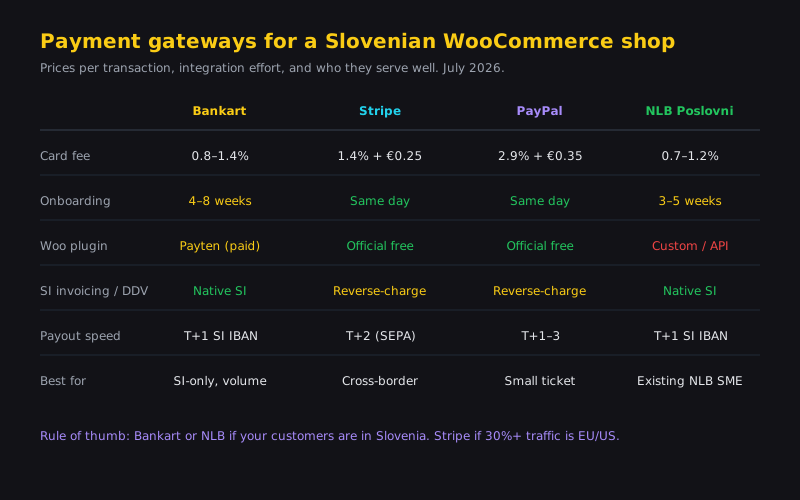
- Payment gateways. Slovenian banks (NLB, NKBM, Intesa Sanpaolo) and local POS providers (Bankart) aren’t first-class Shopify integrations. You can route through Stripe or PayPal, but you lose the UPN-QR bank-transfer flow that a Slovenian buyer expects. On WooCommerce, install
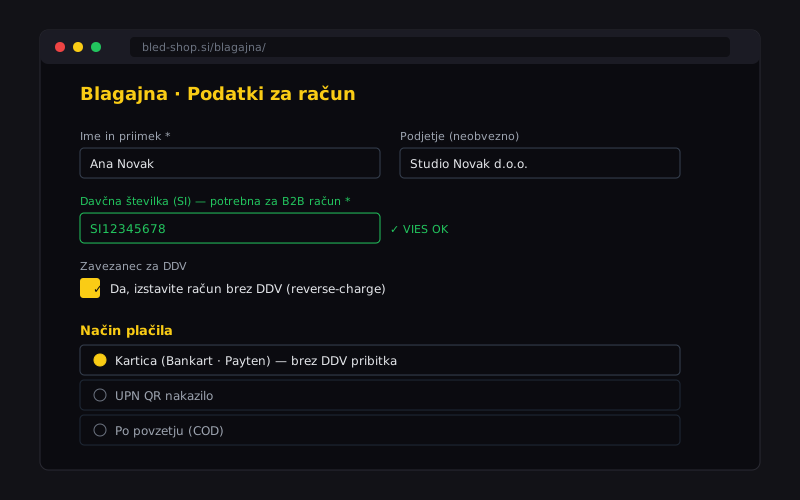
WooCommerce Sloveniaor the Bankart plugin directly and you’re done. - VAT and accounting. 22% VAT with the correct invoice layout, B2B vs B2C handling, the EU OSS threshold, and the e-Davki tie-in are configurable inside WooCommerce with
WooCommerce Germanizedor local tax plugins. Shopify’s baseTaxis fine on the surface, but your accountant will be emailing you “what is this charge” for the next two years. - Ownership. WooCommerce runs on your host, on your domain, with your database. You can move it, copy it, back it up. A Shopify store belongs to Shopify — the day they raise prices 40%, you pay or you leave. Migrating off Shopify is a two-month project; moving between two WooCommerce hosts is a Sunday afternoon.
Magento (now Adobe Commerce) is technically superior for very large catalogs and complex B2B, but it’s overkill for 90% of SMB shops. Baseline monthly costs start north of €1,000, a dev team is mandatory, and every change is a project. It only starts to make sense above roughly €1–2M annual revenue.
The hidden cost of Shopify in 2026
Shopify’s surface price is low. Its recurring real price is not:
- Monthly subscription: €36–399/month depending on plan, and Shopify pushes you up plans faster than you’d expect.
- Revenue cut: 0.5–2% of every euro through checkout if you don’t use Shopify Payments — and Shopify Payments isn’t fully available in Slovenia.
- Apps. Any serious shop ends up with 5–10 paid apps — reviews, post-purchase surveys, loyalty points, advanced filters, weight-and-region shipping rules, multilingual. Each one is €5–30/month. A realistic app bill for a working SMB store is €80–200/month.
- Theme: €200–400 one-time, and once you’ve bought it, your customization options without a developer are narrow.
- Liquid customization developer: €40–120/hour. Any non-trivial change goes through them.
The real Shopify monthly bill for an average SMB shop doing €30–80k/month in revenue typically lands somewhere between €400 and €900/month. A WooCommerce build doing the same volume rarely exceeds €150/month after year one — hosting, plugins, backups, and care included.
What a Slovenian WooCommerce store actually costs
Real ranges from four projects we shipped this year. Ranges are wide because the gap between “30-product catalog” and “Stripe Connect marketplace with multiple suppliers” is enormous.
- EU hosting: €15–40/month for managed WooCommerce hosting (Hetzner managed, Kinsta, WP Engine EU region). Not shared hosting — a shop falls over at 200 concurrent visitors.
- Domain + SSL: €15–40/year for a country TLD, SSL free via Let’s Encrypt.
- Plugin licenses: €150–600/year total. Typical stack: WooCommerce Subscriptions (if you sell subscriptions), Advanced Shipping (zones, weight pricing), Germanized or a local VAT plugin, Yoast SEO Premium for products, WPML for multilingual.
- Payment processing: Stripe or a local acquirer — 1.2–1.8% + €0.25 per transaction. No fixed monthly fee.
- Shipping: integration with the national post office or a courier (Pošta Slovenije, GLS, DPD) through a plugin like
WooCommerce Shipping & Taxor a specialized one — €80–150/year for the license, real shipping rates set by carrier contract. - Accounting export: integration with the local accounting system (Minimax in SI, similar elsewhere in EU), e-invoices — €100–300/year for a ready plugin or a one-time API integration.
- VAT setup: a day of configuration; once you have branches or EU cross-border sales, one hour of an accountant’s time is worth it (€50–100).
- GDPR + cookie consent: included in the build. A ready solution (Complianz, CookieYes) is €50–100/year.
Typical scope ranges, not a quote. The build itself — design, setup, content — scales with scope. A clean catalog of 30–80 products in one currency starts from €2,800. A two-language shop with subscriptions and ERP sync is €5,000–9,000. A Stripe Connect marketplace, where multiple suppliers sell through your platform, runs €10,000–25,000.
Annual operating cost, with no new development, typically lands at €1,800–3,600/year — hosting, licenses, payment fees, care, small content edits.
Hosting and care for a store that can’t afford to go down
A marketing site can be down six hours and nobody dies. A shop down six hours on Black Friday is a wasted month of revenue. A real care plan for a WooCommerce store includes:
- Managed WordPress hosting with PHP 8.2+, Redis object cache, HTTP/2.
- Daily off-host backups, with a tested restore process you actually run monthly.
- 24/7 uptime monitoring with SMS alert and a response SLA under 30 minutes outside working hours.
- Monthly plugin and WooCommerce core updates applied in staging first, only then in production.
- Checkout error monitoring — an alert that fires if no completed transaction has happened in the last hour despite normal traffic.
- PCI-DSS compliance — if you store any card data at all, which most WooCommerce setups don’t need to do (cards go directly to Stripe/local acquirer, never touch your server).
Expect €80–200/month for an honest care plan on a working store. Cheaper offers usually mean there is no care plan — just hosting. This is exactly the scope of our care plans for Slovenian shops, and it’s why we won’t hand over a WooCommerce build without one attached.
A marketing site can be down six hours and nobody dies. A shop down six hours on Black Friday is a wasted month of revenue. If the quote you’re comparing doesn’t specify checkout-error monitoring, tested restores, and an under-30-minute after-hours SLA — you don’t have a care plan, you have a billing arrangement.

Multi-currency and multilingual: when it pays, when it’s overkill
A shop selling only in the eurozone doesn’t need a second currency. Payment clears in euros regardless of who pays. A second currency only matters once you target customers outside the eurozone — Switzerland, the UK, Scandinavia.
A second language (usually English on a non-English site, or the local language on an English site) starts paying once 10% of traffic comes from outside your home market. WPML or Polylang Pro is €100–200/year, translation is €30–80 per product for technical descriptions (less for standard ones). Budget €1,500–3,500 one-time to translate a catalog of 50–100 products properly.
Typical mistake: pushing the catalog through the Google Translate API and publishing without review. Search engines detect this and the translated store gets zero SEO value. It’s better to translate 20 important products by hand than 200 by machine.
Migrating from Shopify, Magento, or Joomla
The flow we run most often is Shopify → WooCommerce. The real gotchas:
- SEO redirects. Shopify’s product URLs (
/products/product-name) need to map 1:1 onto the WooCommerce URL scheme. Without 301 redirects you lose three months of search rankings. - Product data. Shopify’s CSV export covers basic fields. Specs, tags, related-product links, and gallery images need a script that reads Shopify’s API and writes into WooCommerce.
- Order history. Shopify orders don’t migrate cleanly. The practical pattern: leave old orders in a read-only Shopify account until your tax retention period ends, run new orders in WooCommerce.
- Customer accounts. Passwords can’t be moved (they’re hashed). Every active customer gets a “reset your password” email in the week before launch.
- Tracking and marketing pixels. Meta Pixel ID, Google Ads conversions, GA4 — all re-wired and tested in staging before launch.
Migration from Joomla VirtueMart is worse, because the data model is more different. Budget €1,500–4,000 for migrating a medium catalog, translations excluded.
Migration from Magento is surprisingly easy while the catalog is small — Magento already exports structured XML that scripts can carry into WooCommerce. On large catalogs (5,000+ SKUs), the migration itself becomes a 4–8 week project.
How long until launch
- Simple 30–80 product catalog, one language, one payment method: 3–4 weeks if the client supplies photos and descriptions.
- Two-language shop with subscriptions and accounting integration: 6–10 weeks.
- Stripe Connect marketplace with multiple suppliers, loyalty points, region-based shipping rules: 12–20 weeks.
- B2B portal with price tiers, purchase limits, and B2B invoicing: 8–14 weeks.
As with marketing sites, content is the single biggest factor. A client who shows up day one with a structured Excel catalog — descriptions, photos, prices — is live in four weeks. A client who collects content during the build is live in ten.
Common mistakes
Things I’ve watched go wrong, roughly in the order they appear:
- Wrong hosting plan. A €5/month shared host can’t carry WooCommerce. At 50 concurrent visitors the checkout response time goes over 8 seconds and conversions collapse. Start on managed WooCommerce or a Hetzner VPS with PHP-FPM and Redis configured properly.
- Plugin sprawl. Every plugin is more attack surface, more update conflict risk, more code to audit. A healthy WooCommerce stack is 8–15 plugins. If you have 30, half are unnecessary.
- No product analytics. Without GA4
Enhanced Ecommerceyou can’t see where in the checkout people drop off. Without that data, checkout optimization is impossible. - No product SEO basics. Product titles not written for search. Missing
schema.org/Productmarkup. No custom meta descriptions. Each product needs a real title and description, not just the SKU name as the title. - Manual shipping label workflow. Printing labels and copy-pasting tracking numbers is five minutes per order. At 30 orders a day, that’s two hours of manual work. The courier integration costs €80–200 one-time and pays back in two weeks.
- No restore test. “We have backups” is not a care plan. Restore a backup to staging at least monthly and confirm checkout still works. Without that, backups don’t exist — files exist that you hope work.
FAQ
What’s the real WooCommerce vs Shopify cost difference per year? For a store doing €30–80k/month, the three-year gap is typically €8,000–18,000 in WooCommerce’s favor. Most of the gap is Shopify’s revenue cut plus monthly app subscriptions plus theme licensing.
When is Shopify the better choice? When you have no technical resource and never want to touch code, you sell across multiple currencies, and your store is fairly standard (no B2B, no subscriptions, no complex price tiers). Shopify makes sense for a clean D2C shop under ~€200k annual revenue with no customization ambitions.
How fast can I launch a WooCommerce store? With 30 prepared products, one payment gateway, and one language: 3–4 weeks. With subscriptions, two languages, and ERP sync: 6–10 weeks. Without prepared content — twice whatever estimate you got.
What payment gateways work best for WooCommerce in Slovenia? Stripe for fast integration and international buyers, the local acquirer (Bankart in Slovenia) for lower fees and UPN-QR bank-transfer payment, which local buyers expect. In practice you offer both — Stripe for cards, the local gateway for bank transfer.
Do I need multi-currency?
Only when 15% or more of traffic comes from outside the eurozone. Before that, multi-currency is admin overhead with no revenue offset. WooCommerce supports it via WooCommerce Multi-Currency, but accounting gets more complex.
How much does a multilingual store cost? Technically: €100–200/year for WPML/Polylang Pro. Content: €1,500–4,000 one-time to translate 50–100 products by hand (Google Translate isn’t a solution). Maintenance: every new product is a double entry, forever.
Who owns the store? You. Domain, hosting, code, database, content, order exports. All in your name, all portable. If the developer has anything in their own name, you’re renting your own business. Before launch, audit the WHOIS record and the hosting login.
Can I add products myself? Yes. The WooCommerce catalog is a standard WordPress interface — upload photos, write descriptions, set price, pick a category. After a 30-minute walkthrough, anyone can add a product. More complex things (variations by size, coupons, shipping rules) take more practice but stay within reach of a non-technical owner.
If you’re stuck between Shopify and WooCommerce and don’t know which way to jump, that’s normal. At Numen we build stores for small EU businesses — first call is free, written quote, no follow-up gauntlet. Want to see the design and copy first? We ship a full sample store on your own domain before you commit. Related reads: Websites for Slovenian SMBs, EU vs US hosting, or browse recent shops we’ve built.

