
Insights · ai ·
AI for small businesses in 2026: where to actually start
A practical guide on where AI saves a small business one hour a day in 2026 — without the hype, without vendor lock-in, and with a sober look at the EU AI Act and data residency.
TL;DR
- Start where AI already saves one hour a day and repeats: customer Q&A, invoice-to-accounting OCR, quote generation, or RAG over your own docs.
- Real ranges: discovery €800–1,500, single-task MVP €2,500–6,000, multi-agent €6,000–15,000, RAG €3,000–8,000. Inference €10–150/month.
- Skip the €200/month “AI platform” that’s just a UI over the LLM API. Skip long-term contracts. Every 3 months a new model is 30% cheaper.
- EU AI Act since Feb 2026: two things matter — transparency (“you’re talking to AI”) and right to a human. One sentence and one visible button.
Over the last two years I’ve heard every flavor of misframe from small businesses about AI. “We’ll add AI later when we’re bigger.” “We have an AI strategy — we’re investing in a platform that automates everything.” Both are wrong in 2026.
What’s actually happening: customers now expect a service to answer a question instantly. Competitors operating at a 30% lower labor cost are already pricing you out of jobs. And every SaaS tool you already pay for has GPT-4 or Claude inside it — so you’re already paying for AI, you just don’t see it and you don’t control it.
This piece is for small businesses who want to know where to actually start. Not which “AI tool” to buy, but which hour of your day to free up, and how to do it without getting locked into a vendor that floats your data over to the US.
Why “we’ll add AI later” is the wrong frame
Three composited cases from this year — patterns we see repeatedly across our client base, identifying details anonymised and figures rounded:
- A small HVAC service company — gets 8–12 phone calls a day, half of them about pricing and availability. Their receptionist answers the same three sentences 50 times a week. After three weeks of work, a chatbot on their site took over 60% of those calls. Not a generic “AI assistant” — a specific knowledge base of 30 questions and 30 answers the owner wrote himself.
- A small accounting firm — spent 12 hours a week typing supplier invoices into their accounting system. After one week of work: photo of incoming invoice → JSON extract → API insert into the accounting system. Twelve hours dropped to ninety minutes a week. Inference cost: €4/month.
- A B2B hardware seller — wrote each quote in 45 minutes manually, reading PDF specs and typing into Word. A multi-agent system (one reads PDF specs, one drafts the quote text, one calculates price based on customer’s tier) returns a draft in 4 minutes; the seller reads it and sends it. 45 minutes to 8. By year-end that’s 200 extra quotes.
None of these are “AI strategy”. They are infrastructure wins — like the website rebuild was two years ago. Once your competitor has this, you have nothing to leapfrog them on — except being 30% more expensive per hour of work.
The “AI hype tax” — what NOT to buy
In 2026 the market is full of UIs on top of GPT-4 and Claude that add no real value beyond a slick interface. The rules I use:
- No €200/month platform that’s just a UI over the LLM API. You’re paying €200 for something that costs €4–15 directly at OpenAI or Anthropic. The delta doesn’t pay for “magic”; it pays for the vendor’s marketing team.
- No RAG-as-a-service where they store your documents. Your contracts, invoices, HR records — go into their database. You don’t control location, export, deletion. When the vendor pivots or gets acquired, your data sits where it sits. Cheaper and safer: self-hosted ChromaDB or Qdrant on Hetzner, vectors stay with you.
- No generic “AI agent” chatbot with a universal knowledge base. A customer asking your elevator price doesn’t need a system that knows Wikipedia. They need a system that knows your 25 elevator prices and answers honestly “I don’t know that, the sales lead will call you in two hours” for everything else.
- No long-term contracts. Given how fast LLMs improve (every three months a new model is 30% cheaper or better), a 12-month fixed-price contract is a bad idea. Pay per usage, swap models as they ship.
Where AI actually saves a small business one hour a day
After two years of building these systems, four patterns work reliably. Not every business needs all four, but every business has at least one.
1. Customer Q&A automation. 50–80% of customer questions repeat. Pricing, lead times, warranties, hours. A chatbot with a well-prepared FAQ and a fallback to a human handles 50–70% of those calls. Typical build cost for a small business: €1,500–3,500. Inference cost: €8–40/month.
2. Document-to-data extraction (OCR + LLM). You receive a supplier invoice as a PDF, you re-type it into your accounting system. You receive an inquiry by email, you re-type it into the CRM. That’s 1–3 hours of daily manual work. A system that reads documents via gpt-4o vision or claude opus 4.7 (LLM reads the PDF directly) and pushes the extract into your accounting system or CRM is 2–4 weeks of work. Cost: €2,500–6,000 one-time, €10–60/month inference.
3. Quote and document generation from CRM data. You have customer data in CRM, pricing tiers in Excel, a standard quote template in Word. A system that pulls all three and assembles the quote in one click. Multi-agent that reads CRM, calculates pricing, generates a PDF, and sends it for signature. Build cost: €4,000–10,000. Inference cost: €20–80/month.
4. Search over your own knowledge base (RAG). You have 200 internal documents — contracts, technical specs, process manuals. Employees search them for information and waste 30 minutes a day. A RAG system that reads all documents and answers in natural language saves 15–30 minutes per employee per day. Build cost: €3,000–8,000. Inference cost: €15–80/month, vector database another €5–15/month.
One important note: all four patterns can be built in-house if you have one technical employee. The build cost isn’t in “AI magic” — it’s in integration with your CRM, accounting, ERP, and in iterating the prompt until it answers correctly in 95% of cases.
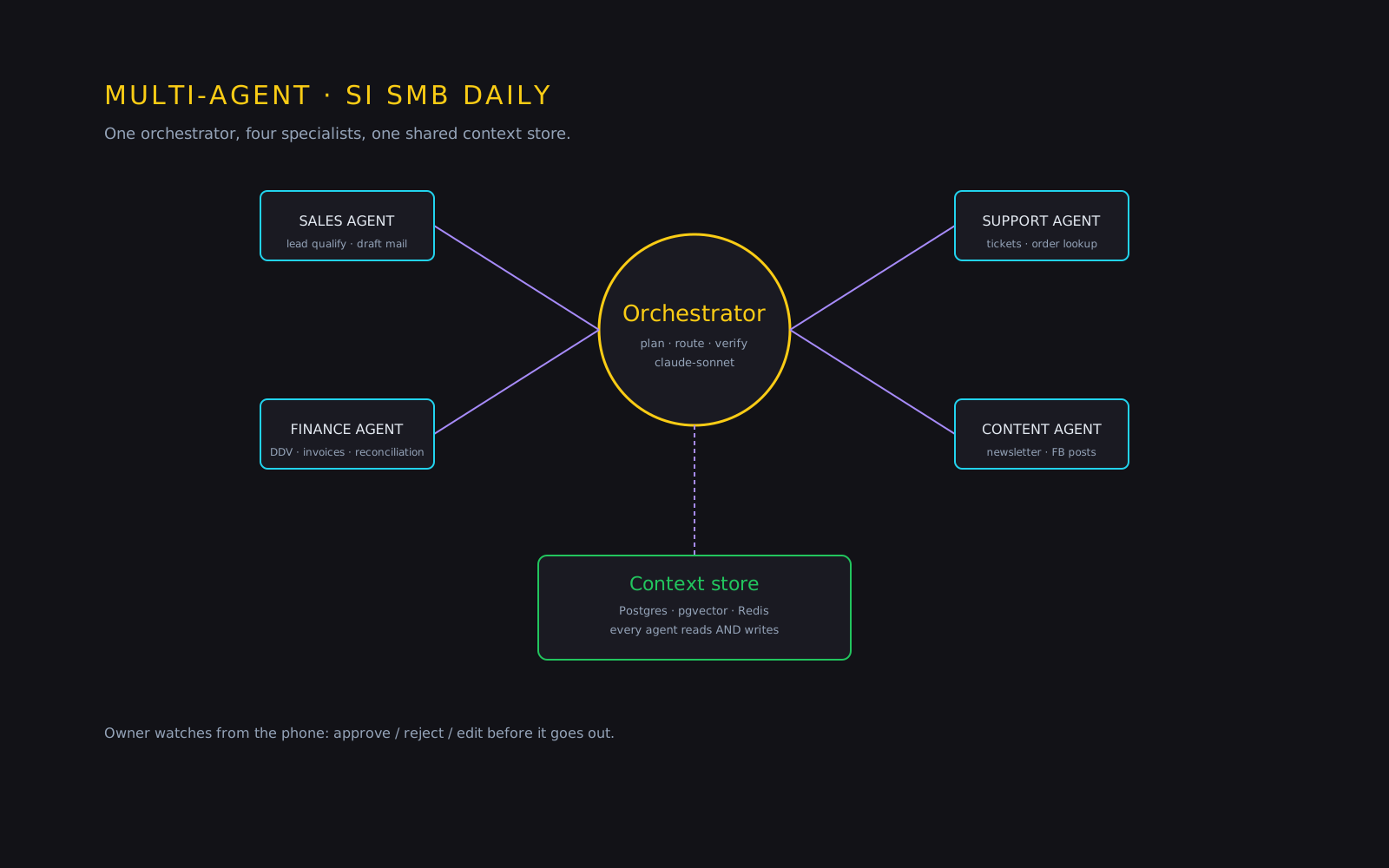
Single-task vs multi-agent: when to use which
Single-task (one LLM call, simple logic): a chatbot on the site, OCR an invoice, translate an email. Good for 80% of small-business cases. Low build cost, low maintenance, low inference cost.
Multi-agent (multiple LLM calls handing off work, each with a specific role): assembling a quote from CRM data, where one agent reads CRM, one calculates pricing, one writes the body, one translates to English. Justified only when the task is too complex for a single prompt, and where the quality of the final result depends meaningfully on specialization.
Typical mistake: building a multi-agent system for a task that one well-prompted LLM call would solve in 5 seconds. Every additional agent layer adds 800ms–2s of latency, adds inference cost, and adds error surface. Start with single-task. Move to multi-agent only when single-task demonstrably falls short.
The EU AI Act and why data residency matters
The EU AI Act is in full force from February 2026. For most small businesses, it doesn’t mean much — they’re not in “high-risk” categories. But it does mean two things:
- Transparency. If you use AI to answer customers, you must tell the customer they’re talking to AI. Trivial: one sentence in the chat widget footer.
- Right to a human. A customer has the right to demand a human, not AI. The system needs a visible “talk to a person” button.
On data residency: if you send customer data to OpenAI (US), the data is in the US. Schrems II and the EU-US Data Privacy Framework still legalize this in 2026, but an EU-first approach increasingly makes sense:
- Mistral AI (Paris) ships Mistral Large 2, which is good enough for most small-business use cases, and data stays in the EU.
- Anthropic and OpenAI offer EU regions on Enterprise tier, but it’s expensive for a small business.
- Self-hosted Llama 3 on Hetzner (Germany) is a real path for businesses with highly sensitive data (healthcare, finance). Operating cost: €300–800/month for a GPU server.
Practical rule: for a chatbot that answers public questions (pricing, hours), use any LLM. For a system that reads internal documents (HR, financial, clinical), use EU-hosted or self-hosted.
What entry actually costs
Typical scope ranges, not a quote. Ranges from small-business projects this year, VAT excluded:
- Discovery sprint (3–5 days of work: understanding processes, picking the use-case, ROI estimate, technical plan): €800–1,500.
- MVP single-task system (chatbot, OCR, one automated flow): €2,500–6,000 build + €10–60/month inference.
- MVP multi-agent system (quote assembly, sales pipeline automation): €6,000–15,000 build + €30–150/month inference.
- RAG system for internal knowledge base (200–2,000 documents): €3,000–8,000 build + €20–100/month inference + vector database.
- EU-hosted or self-hosted setup (for regulated businesses): an additional €1,500–4,000 one-time + €200–800/month.
Maintenance (model updates, prompt fixes, adding new questions to the knowledge base): €200–600/month for the first six months, less after.
How to pick the FIRST use-case: the “one hour a day” test
Every business that asks me where to start, I walk through the same question: what task takes you one hour every day and repeats?
If the answer isn’t obvious, ask the employees. Not the leadership. The receptionist, the salesperson, the bookkeeper. The people who actually do the work know what’s wearing them down. Leadership often doesn’t, because they don’t do that work.
Most common answers in small businesses:
- “I answer the same phone questions all day” — chatbot.
- “I re-type invoices into the accounting system” — OCR + LLM.
- “I write quotes from the same template” — multi-agent.
- “I search for old agreements in our contracts” — RAG.
Pick one. Not two. Prove ROI in 6 weeks, only then start the second.
Practical rule of thumb for the first project: if the saving is 1 hour/day at €25/hour, that’s €500/month recovered. A €3,500 MVP pays back in 7 months. Anything a vendor quotes above €10,000 for a first project — where they can’t show you a comparable case with numbers — is speculation, not engineering. That’s the same discipline behind every AI integration we ship and the production-shipping checklist.
Common mistakes
- Buying a chatbot before you know which 50 questions it should answer. Without a prepared Q&A knowledge base, a chatbot is generic and hallucination-prone. First write 50 questions and 50 answers. Then the chatbot.
- Multi-agent before validating single-task. See above.
- Vendor that locks in your data. All meaningful data (vectors, prompts, Q&A knowledge base) must be yours, exportable in a standard format (JSON, PostgreSQL dump).
- No evaluation. How do you know the system is better after a model update? Have 50 test cases with expected answers. After every change (new model, new prompt, new content) run them through. Without that, you don’t know if you improved or broke things.
- Inference costs that escape control. A system in production that calls GPT-4 twice for every question is expensive. Track monthly spend, cache answers for frequently repeated questions, use smaller models for simple tasks.
- AI without a “fallback to human”. Every AI system needs a path to escalate to a person when it gets lost. A customer who gets five “I don’t understand” in a row doesn’t come back.
FAQ
Where should a small business start with AI? With one task that takes you an hour every day and repeats. Usually: a chatbot for frequently asked questions, or invoice-to-accounting automation. Don’t start with “AI strategy” — start with one hour of saved time.
ChatGPT, Claude, or Mistral for a small business? All three are good in 2026. For most languages, Claude Opus 4.7 and Mistral Large 2 are the most natural. For cases where data location matters, prefer Mistral (Paris) or EU-hosted Llama 3.
Where is my data in the EU? If you use OpenAI or Anthropic in the default region — in the US, under the EU-US Data Privacy Framework. If you use Mistral — in Paris. If you self-host Llama 3 on Hetzner — in Germany. All three are legal; for regulated businesses, EU location is strongly preferred.
Do I need RAG? Only if you have more than 50 internal documents that employees actually read to find information. Below that, plain Notion/Confluence search is enough.
What is a multi-agent system? Several LLM calls handing off work, each with a specialized role. For example: one agent reads CRM customer data, one calculates pricing, one writes the quote body, one translates to English. Justified when one LLM call can’t handle the complexity.
Can I do this myself with no-code tools? For very simple flows (n8n, Make, Zapier with OpenAI integration) — yes. For anything that requires integration with your CRM or accounting plus real error handling — no. No-code breaks 3–6 months in, once the system gets serious.
What does it cost monthly once the system is live? For a chatbot at 1,500 questions/month: €8–40 inference + €100–200 maintenance. For an OCR system at 200 invoices/month: €15–60 + €150–300 maintenance. For a RAG at 500 questions/month: €30–80 inference + vector database €5–15 + €200–500 maintenance.
How long until ROI? On a well-chosen use case: 2–4 months. If the saving is 1 hour/day at a €25/hour rate, that’s €500/month saved. An MVP that costs €3,500 pays back in 7 months.
If you’re staring at a “buy this AI platform for €200/month” decision and you’re not sure it’s right, it’s worth a second look. At Numen we build concrete AI systems for small businesses — first call is free, written quote, no vendor lock-in. For the production-side of the same decision, see how to ship a real LLM feature; for the hosting-jurisdiction question underneath it, see EU vs US hosting for SMBs; or browse our recent work to see AI systems already in production.

