
Insights · care ·
Anyone can build a website with AI. Who keeps it running?
Anyone can build a website with AI in an afternoon. But who updates it, secures it and keeps it fast as your business grows? What upkeep really means.
In two sentences: With today’s AI tools, almost anyone can put up a professional-looking website in an afternoon. The hard part comes after launch: updates, security, speed, backups, changes as the business grows and visibility on Google, and that is what decides whether the site is still bringing in customers a year from now.
The short answer: AI can build you a website, but it can’t look after it on its own. A website isn’t a poster you print once. It’s a system that runs on a server, depends on code, plugins and services written by other people, and lives in an environment that never stops changing. So the question is no longer whether you can build a site yourself. It’s who will be responsible for it six months from now.
What AI genuinely does well
Let’s be fair: tools that turn a few sentences into a complete website have come a very long way in the last two years. In a few hours you get a design, copy, images and a working site on your own domain. For many businesses that’s a great start, and far better than an outdated site or no site at all.
Building it isn’t the problem. The problem is that launch day is the first day of a website’s life, not the last.
What happens after launch
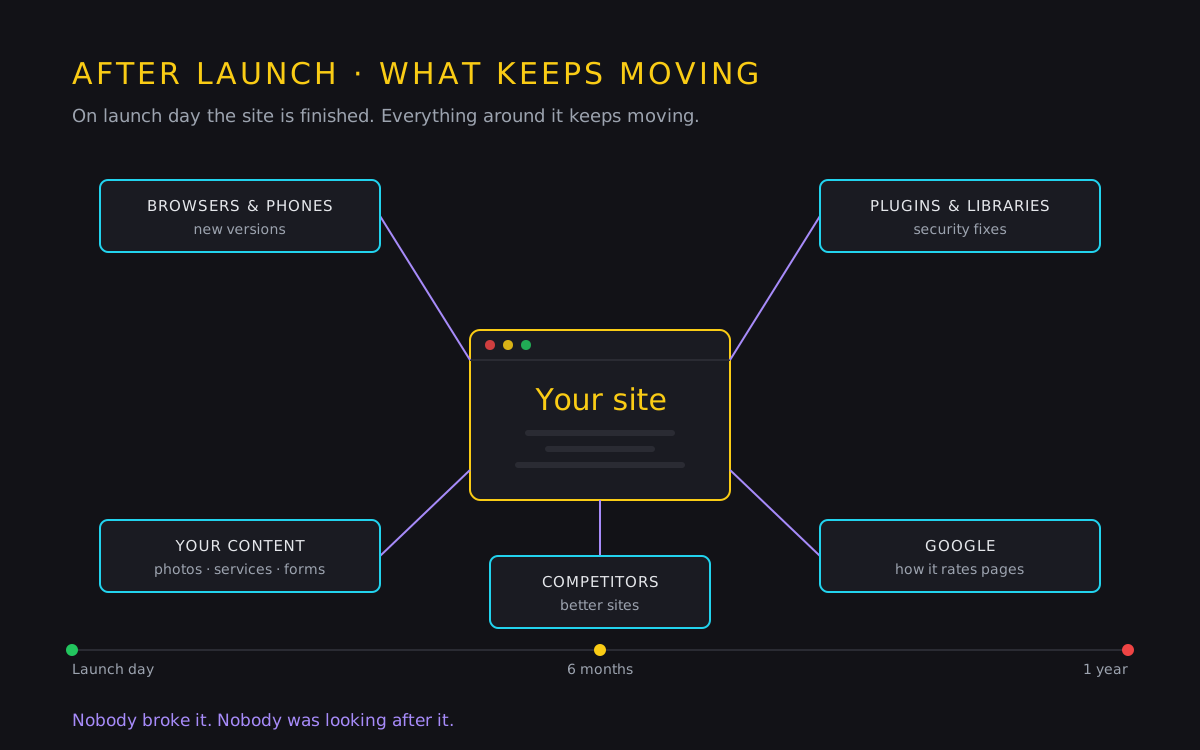
Once the site is live, everything around it keeps moving:
- browsers and phones get updates,
- the plugins and libraries the site depends on get security fixes, or get abandoned by their authors,
- you add photos, copy, new services and forms,
- Google changes how it evaluates pages,
- your competitors improve their own sites.
A site that ran flawlessly at launch can, a year later, load more slowly, carry a vulnerable plugin and show a broken menu on mobile. Nobody broke it. Nobody was looking after it.
Speed: fast at launch, slow a year later
Sites don’t slow down on their own; we slow them down. Every full-resolution photo, every chat widget, ad tracker or embedded video adds a fraction of a second. Together that quickly adds up to a second or two, and a visitor on a phone with patchy signal feels every bit of it.
Speed isn’t just about comfort. Google measures how quickly a page loads, how fast it responds to a tap and whether content jumps around while loading (Core Web Vitals), and it explicitly recommends site owners keep these numbers good because they align with what its ranking systems reward. Maintenance means someone tracks those numbers regularly and acts before your customers notice.
Security and updates: code you didn’t write
Every modern website is built on other people’s code. On WordPress that means plugins and themes; on modern frameworks such as Astro it means libraries; on AI website builders it means the platform plus whatever code the tool generated for you. Vulnerabilities are found in that code all the time, and fixes follow. For WordPress, Patchstack found that 91% of new vulnerabilities in 2025 were in plugins, not in WordPress itself (State of WordPress Security in 2026).
A site written entirely by AI raises one more question: does anyone actually know what’s inside it? If nobody understands the code, nobody can update it safely. When something breaks, the next request to the AI to fix it is often a guess that fixes one thing and quietly breaks another.
Good maintenance comes down to three simple things: regular updates, fast security fixes, and every change tested before it goes live. We cover what a fair care plan should include in Care plans that actually pay off.
Backups: irrelevant until you need one
Everyone knows backups matter. Few people check whether they actually have them, where they’re stored and whether they can be restored. A backup nobody has ever tried to restore is a hope, not a backup.
Ask yourself: if your site disappeared tomorrow because a subscription lapsed, someone broke in or the provider closed the account, how quickly would it be back online? Where are your texts and photos? Who has access to the domain? You want answers to those questions before anything happens. We wrote about where your data should live in EU-hosted vs US-hosted for Slovenian SMBs.
Changes as the business grows
Your business changes and your site has to keep up: a new service, a new price list, a second language, online ordering, bookings, a sign-up form, a link to your accounting software. Each change is small, but together they decide whether the site helps the business or holds it back.
On a site that AI generated without a clear structure, every new request is harder than the last. It often ends with the site being regenerated from scratch, and each new version loses something that used to work: a link, a piece of copy, a setting Google relied on. A site built with future changes in mind grows with you.
Visibility on Google and in AI search
A beautiful site nobody finds doesn’t bring in customers. Existing isn’t enough to be found. What counts is that the site is fast, clearly structured with proper headings, shows correct business details (address, phone, opening hours), is connected to your Google Business Profile and gets fresh content regularly.
People also search differently now. More and more of them ask ChatGPT, Gemini or Perplexity instead of a search engine. These tools find it easier to summarise pages that answer a question clearly, have tidy structured data and are technically sound. That isn’t a one-off job at launch either; it’s part of the ongoing work on a site.
Yes, we use AI too
Of course. At Numen we use AI every day, because it lets us work faster and get more done. But AI is a tool we guide: we decide what gets built, review every change and stand behind the result. We’ll describe how that works in practice in a separate post soon. For where AI genuinely helps small businesses, see AI for small businesses in 2026.
When a do-it-yourself AI site is perfectly fine
Not every site needs ongoing care. If you need a simple online business card for a short project, an event or to test an idea, a site from an AI builder on its own platform can be enough, as long as the platform itself takes care of hosting and updates.
It’s different once the site works for you: it brings in enquiries, bookings or orders, collects personal data, or you rely on it to find new customers. Then you need someone who’s responsible for it.
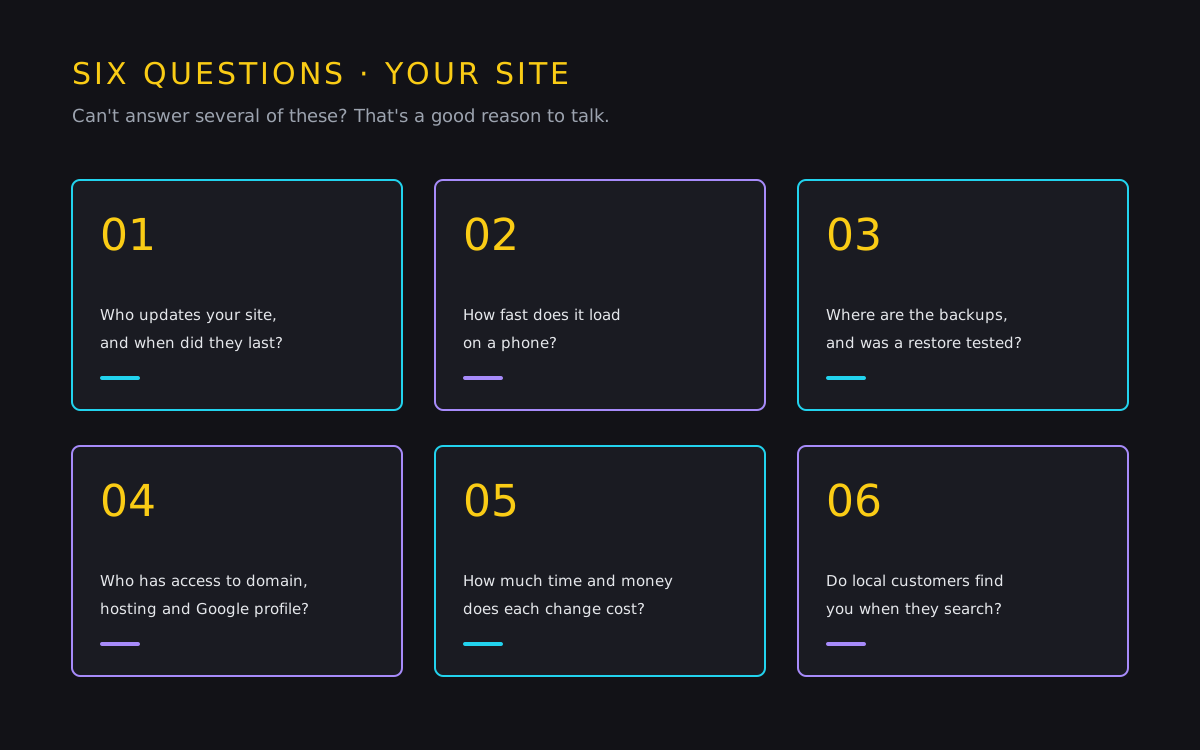
Six questions to ask about your site
- Who updates your site, and when did they last do it?
- How fast does it load on a phone?
- Where are the backups, and has anyone ever tested a restore?
- Who has access to the domain, the hosting and your Google Business Profile?
- How much time and money does each new change cost you?
- Do customers find you when they search for your service in your town?
If you can’t answer several of these, there’s no need to panic. It is a good reason to talk.
How we can help
At Numen we look after sites after launch too: managed hosting, uptime monitoring, regular updates and security patches, daily encrypted backups, small updates and a monthly performance report. The details are on Hosting & ongoing site care.
If you built your site yourself with AI and aren’t sure what it’s missing, get in touch. We’ll look at what makes sense for your site together, even if you decide to keep looking after it yourself.
FAQ
Can I use a website built by AI for my business? Yes. Today’s AI tools produce usable sites that are a perfectly good start. What matters is knowing who will update, secure and adapt the site after launch, because AI doesn’t do that on its own.
What does website maintenance include? Maintenance usually covers hosting, regular updates and security patches, backups with tested restores, uptime and speed monitoring, and small content changes. The goal is a site that stays secure, fast and visible on Google for years after launch.
Why does a website get slower over time? Most often because of new large photos, added scripts such as chat widgets and ad trackers, and outdated plugins or libraries. Speed needs measuring regularly, and Google recommends that site owners keep good Core Web Vitals.
Does a site I never change still need maintenance? Yes. Even if your content stays the same, browsers, plugins, libraries and security threats keep changing. A site without updates becomes slower and more vulnerable over time, even if nobody touches it.
Does Numen use AI in its work? Yes. Numen uses AI every day because it lets the team work faster and get more done. AI is a tool guided by people: the team decides what gets built, reviews every change and stands behind the result.
Sources
- Understanding Core Web Vitals and Google search results, Google Search Central
- State of WordPress Security in 2026, Patchstack, 2025 data


