Insights · fractional-cto ·
Fractional CTO vs technical advisor vs CTO-as-a-service : the actual differences
Three terms founders use interchangeably when shopping the senior-engineering market. They're not the same — pricing, accountability, hours, and presence all differ. Here's the disambiguation.
TL;DR
- Advisor: 1–4 hours/month, no decision rights, equity or €500–2k retainer. Best pre-seed when you need judgment, not execution.
- Fractional CTO: 8–20 hours/week per company, real decision rights, €4–10k/month. The shape that fits pre-seed through Series A.
- CTO-as-a-service: productized tiers, contract with a firm not a person, continuity risk. Best for established companies filling a seat.
- The three aren’t cheaper vs pricier versions of each other — they’re different products for different problems. Pick the shape, then the vendor.
When founders email me, they almost always use three terms interchangeably: fractional CTO, technical advisor, CTO-as-a-service. Same inbox, same week, same problem framing. And I get it — from the outside, they all look like “buy senior engineering judgment by the hour.” But they’re not the same product. The pricing differs. The accountability differs. The hours differ. The presence differs. Pick the wrong shape for your stage and you’ll burn runway buying a thing that can’t solve the problem you actually have.
This post is the disambiguation. Three shapes, what each one actually is, when it’s right, and where each one fails.
The technical advisor
Lowest commitment, highest distance. The advisor is usually a friend-of-founder with senior credentials — ex-CTO at a name-brand company, current VP Engineering somewhere relevant, or a founder who exited and now gives back. They’re a person you can call, not a person who’s in the codebase.
Hours: 1–4 per month. Maybe a 45-minute call, maybe two. Occasional Slack ping when something specific comes up.
Cadence: Monthly, sometimes quarterly. Not in your team’s daily flow.
Decision rights: Zero. The advisor gives opinions; the founder still owns the call. There’s no “the advisor said we ship this” — and there shouldn’t be.
Pricing: Either equity (typical range 0.25–1% vested over 2 years) or a modest cash retainer (€500–2000/month). Sometimes both.
When it’s right: Very early stage. You’re pre-seed or seed, your team is tiny, and the question you actually have is “is this technical judgment call reasonable?” — not “can someone help me execute on it?” An advisor is also useful when you specifically need a name on the team page for credibility reasons.
Failure mode: The advisor has no skin in actual delivery. You can call them when something breaks, but they were never in the room when the decision that broke it was made. If your problem is “I need someone who owns the technical direction with me”, an advisor cannot be that person. They have other day jobs.
The fractional CTO
Middle commitment, embedded. The fractional CTO is a senior engineer who runs a portfolio of 2–4 companies in parallel and is actually present in each one — not just on retainer for it.
Hours: 8–20 per week per company. Real presence, real time blocks.
Cadence: Standups, sprint planning, code reviews when needed, in the Slack workspace daily. The team learns to ping them like any other senior on the team.
Decision rights: Real. They sign off on architecture, vendor choice, senior hires, and any decision the founder doesn’t want to make alone. They’re accountable for outcomes, not just opinions.
Pricing: Monthly retainer tied to hours — roughly €4–10k/month depending on scope and seniority. Some take a small equity component on top, most don’t.
When it’s right: Pre-seed through Series A. No full-time CTO yet, but you’ve outgrown the “advisor on a monthly call” shape. You need senior judgment in the room consistently — not just when you remember to escalate. For a deeper read on when this shape fits, see my earlier post on fractional vs full-time.
Failure mode: Founder treats the fractional like an advisor. Asks for opinions, doesn’t give authority, doesn’t loop them into the actual decision moments. You hired someone for embedded leverage and then used them as a once-a-month sounding board. That’s a waste of your money and their time, and it’s the single most common way fractional engagements quietly fail.
CTO-as-a-service
Highest packaging, lowest customization. CTO-as-a-service (CaaS) is the productized version of the above — usually offered by agencies or staffing-style firms. You pay for a tier, you get a named engineer assigned to you.
Hours: Defined by tier. Typical structure: 8 hours, 40 hours, or a full month of dedicated time.
Cadence: Defined by tier. Lower tiers feel like advisor pacing; higher tiers feel like fractional pacing.
Decision rights: Usually delegated to whichever named engineer is assigned that month. The contract is with the firm, not with the person.
Pricing: Productized. €X/month for tier Y, listed on a pricing page. Transparent, predictable, and easy to compare.
When it’s right: Scaling agencies and consultancies that need a “fill the slot” relationship with a vendor, not a person. Also useful for established companies that want a known monthly cost and don’t care which specific senior name is in the seat — they just need the seat filled by someone competent and on-call.
Failure mode: Continuity. The named engineer in month 1 may not be the one in month 6. Senior engineering decisions don’t compose well across switching hands — context evaporates, opinions diverge, and the founder ends up re-explaining architecture choices to a new person every quarter. For early-stage work where the technical direction is still being set, this is a real problem.
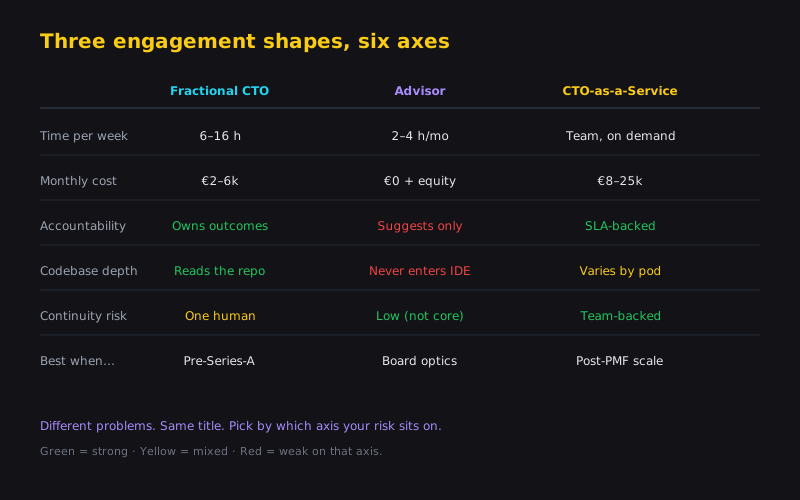
Side-by-side at a glance
| Technical advisor | Fractional CTO | CTO-as-a-service | |
|---|---|---|---|
| Hours/week | <1 | 8–20 | 2–40 (tiered) |
| Decision rights | None — advice only | Real — signs off | Delegated to assignee |
| Accountability | Reputation | Outcomes | Contractual (firm) |
| Pricing | Equity or €500–2k/mo | €4–10k/mo | Productized tiers |
| Best stage | Pre-seed | Pre-seed → Series A | Established / agency |
The three shapes line up on a spectrum: advice-only on one end, embedded-and-accountable in the middle, productized-and-swappable on the other. None of them is better in the abstract. They’re different products for different problems.
The shape Numen does
Honest framing: I run as fractional, not advisor and not CTO-as-a-service. The reason is the same reason I left the consulting model years ago — I want to be in the room when the decisions get made, not just on the call when the decisions get reviewed. And I want to know the codebase well enough to be useful, not just well enough to have opinions.
That shape paid off most clearly at CryptoUnity, where I was the embedded CTO across three consolidated codebases, surfaced and resolved a stack of audit issues, and helped pass two regulatory launches. None of that work composes across switching hands. It needed presence, not packaging. That’s what our Strategic & Advisory tier is scoped for, and why the first 90 days look nothing like an advisor call.
The disambiguation matters
You’re picking a shape, not just a vendor. The shape that fits your stage either compounds your velocity or wastes your runway — and the three shapes above are not interchangeable, no matter how similar the pricing pages look.
If you want to figure out which shape fits, book a free 30-minute call and we’ll sort it together. Or read the fractional vs full-time decision framework first, then browse recent work to see what an embedded engagement actually looks like inside a team.


