
Insights · fractional-cto ·
Fractional CTO vs full-time hire: when each actually makes sense
A fractional CTO and a full-time CTO are different tools for different problems. Here's the actual decision framework I use with founders — based on stage, cash, and what's currently broken.
TL;DR
- Fractional wins when you have a decision problem, not an execution problem — 4-8 senior hours per week beats 40 hours of code.
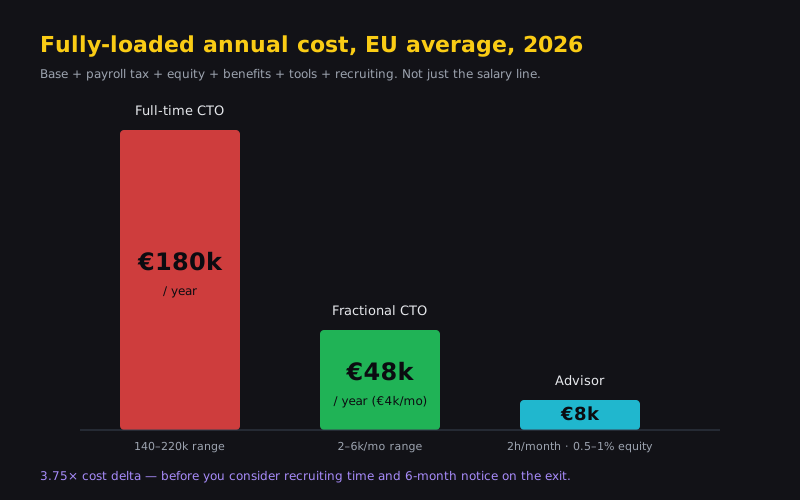
- Full-time wins post-Series A with 10+ engineers and a hiring-velocity bottleneck — a €200k CTO comp package needs the org to fill it.
- The bridge model (fractional now, full-timer in 6-12 months) is the shape investors respect most and the one I run most often.
- The mistake is framing this as fractional-vs-full-time — they’re different jobs. Pick the job you actually need right now.
Most founders ask me about fractional CTO engagements when something’s broken. The site keeps falling over. The team they hired isn’t shipping. The investor due-diligence call exposed something the founder can’t answer. Usually, the actual question underneath is: “Should I hire a full-time CTO instead?”
The honest answer depends on three things, in this order: what’s currently on fire, how much runway you have, and whether the technical work is your moat or just plumbing. Here’s the framework.
When a fractional CTO is the right call
You have a decision problem, not an execution problem. You don’t need 40 hours a week of someone writing code. You need 4-8 hours a week of someone in the room when architecture decisions, vendor choices, hiring loops, and board-level technical questions come up. A fractional gives you senior judgment at the moments that count — what the Strategic & Advisory tier is built for.
Concrete signals that point to fractional:
- You’re pre-Series A, the team is 1-5 engineers, and they’re shipping fine — but you have no one with prior CTO experience reviewing what they ship
- You’re between technical co-founder and full-time CTO — the co-founder left or never existed, and hiring a real CTO takes 4-6 months
- You need technical credibility in fundraising — investors want a CTO name on the team page, and a fractional CTO who’s done it before reads better than an inexperienced full-timer
- You have specific technical risks to manage — fintech audit prep, AI integration discovery, post-incident architecture review
In all these cases, you don’t need someone full-time. You need someone with scar tissue at the right moments.
When a full-time CTO is the right call
You have an execution problem disguised as a decision problem. You’re past Series A, you have 10-20+ engineers, and the bottleneck is no longer “what should we build” but “we can’t ship fast enough” or “we can’t recruit fast enough.” That’s a full-time job — recruiting, performance management, cross-functional negotiation, retention. Fractionals don’t have the time presence to do that work.
Concrete signals:
- Engineering is more than 50% of headcount and you have multiple sub-teams (frontend, backend, mobile, ML, etc.)
- Hiring velocity is the bottleneck — you need 10+ engineers in the next 12 months and need someone full-time running the loop
- The technical work IS the product — not a website that supports the business, but the actual thing customers pay for (developer tools, infrastructure, AI platform)
- You’ve raised Series A+ and have 18+ months of runway for a $180-250k+ all-in CTO comp package
If you’re in this zone, fractional doesn’t scale. You’re paying for hours-per-week, but the job requires presence-and-context-all-the-time.
The honest middle case
This is where founders get stuck. Sometimes you’re in the murky middle:
- 7-12 engineers
- $80-120k MRR
- Series A closed but only 14 months runway
- Engineering shipping fine, but you sense you’re about to grow past your existing senior engineer’s experience ceiling
Here’s what I usually recommend: fractional CTO for 6-12 months while you start the full-time search. The fractional fills the leadership gap, runs the recruiting loop with the founders, and — critically — helps you write the JD and interview rubric for the full-timer. When the full-time CTO joins, the fractional rolls off cleanly. This was the shape of my GetThrivin engagement — I joined as Fractional CTO at the scaling phase and stepped back as the team matured.
This is the bridge engagement. It’s the most common shape I run, and it’s the shape investors respect — it shows founders making senior decisions on a real timeline. The mechanics of how those first three months actually run — audit, spend review, architecture calls, hiring readiness — are in my note on the first 90 days of a fractional CTO engagement.
”Fractional and full-time aren’t cheaper or more expensive versions of each other. They’re different jobs.”
— This post’s thesis
What founders usually get wrong
1. Hiring a full-time CTO too early. A $200k+ comp package eats 12-15% of a $1.5M Seed round. If your engineering team is 1-3 people and shipping fine, you’re paying for org capacity you can’t fill. The full-timer ends up writing code instead of being a CTO, which is a waste of both their salary and yours.
2. Hiring a fractional CTO too late. If you’re already at 15 engineers and missing your sprint goals, a fractional showing up 8 hours a week can’t fix that. By that point, you needed full-time leadership six months ago.
3. Hiring a fractional who’s actually a consultant. There’s a real difference. A fractional CTO is embedded — they show up to your standups, they get pinged on Slack, they have an opinion about your roadmap because they helped write it. A consultant writes a report and disappears. If your “fractional” doesn’t have a weekly cadence with your team, they’re a consultant. That’s fine if you wanted a report, but it’s not the same product. (At CryptoUnity, I was the actual CTO — 8 integration phases, three codebases consolidated, in the room for every architecture call. That’s the embedded shape; a consultant could not have shipped that.)
4. Not writing down what the engagement is. Both shapes — fractional and full-time — need a written scope. For a fractional: hours per week, decision rights, deliverables, escalation path. For a full-time: same plus the org chart, equity, and a 30/60/90 plan. Founders who skip this get a year in and realize they’ve been paying for “advice” with no accountability.

The decision in one paragraph
If you’re pre-Series A with 1-7 engineers and your problem is what to build, who to hire, and how to not break in production, hire a fractional. If you’re post-Series A with 10+ engineers and your problem is shipping faster, recruiting, and managing cross-team complexity, hire a full-time. If you’re between those two zones, hire a fractional as a bridge and use them to land the full-timer.
The mistake to avoid: framing it as fractional-vs-full-time. They’re different jobs. The question is which job you actually need right now.
If you want to talk through which shape fits your current situation, book a free 30-minute call. I’ll tell you honestly whether I’m the right fit or not — and if I’m not, I usually know someone who is. If you’ve already decided the shape and want to compare it against the neighbouring options, see fractional vs advisor vs CTO-as-a-service, or look at our recent build work for the kinds of teams these engagements land inside.

