
Insights · saas ·
The era of personalized SaaS: building your own is now the cheaper option
For fifteen years build-vs-buy was settled in favor of buy. In 2026 the math flipped: for the 2–3 SaaS an SMB pays most for and uses least of, custom now wins. Why, and how to approach it.
TL;DR
- For fifteen years “always buy SaaS” was correct arithmetic. In 2026 the math flipped.
- AI-assisted development has collapsed the cost of well-scoped internal tools by 3–5x since 2022.
- For the 2–3 SaaS subscriptions where you overpay and underuse, custom now wins over a two-year horizon.
- Written for SMBs with a SaaS bill above €1,000/month who use less than a third of what they’re paying for.
In March 2026 we sat with a client in Ljubljana — illustrative composite of the pattern we see every week, details anonymised. The director opens his subscriptions spreadsheet and reads out loud: Salesforce Starter, HubSpot Starter, Notion Plus, Airtable Pro, Monday Pro, Zapier Starter, Zoho One for three people, plus two smaller tools. Eight users. Ask him how much of each tool they actually use — a pause, then: “Maybe a quarter. Probably less.” Seven subscriptions, four quarters, one spreadsheet, one visible tear — a four-figure monthly SaaS bill for a team of eight.
That isn’t an outlier. That’s the average Slovenian SMB in 2026.
Read this next sentence twice: for the 2–3 SaaS subscriptions you pay most for, custom is now cheaper than renting. Not for all of them. Not for small ones. But for the ones where you pay €200 a month for four features and use one — the math flipped.
Why “buy” was the right answer for fifteen years
Between 2010 and 2023 the build-vs-buy debate was almost always won by SaaS. And rightly so. Custom development of an internal CRM or project tool meant six-figure builds and four-figure monthly maintenance, plus DevOps cost, plus the risk that the developer who built it would leave in eighteen months.
Salesforce cost €25 per seat. HubSpot €20. Notion €10. For eight users that was €200–500 a month — versus €150,000 up front. Nobody who could do arithmetic picked custom.
Cloud economics only accelerated it. AWS and Heroku made development cheaper in theory but added three extra layers of complexity — CI/CD, containerization, monitoring — that required a dedicated engineer. So: SaaS won because custom got three times cheaper than in 2005, and SaaS got ten times cheaper than in 2005.
Everyone accepted this as a law of nature. That was a thinking mistake. It was a snapshot of economics. Which changed.
”The math flipped.”
— what the last three years actually mean
What shifted between 2024 and 2026
Three moves at once. First and largest: AI-assisted development. Claude Code (Anthropic), Cursor, Aider, GitHub Copilot, and Windsurf changed how much of a competent developer’s day converts into shipped code. On well-scoped internal tooling — CRMs, pipelines, dashboards — we’re talking 3–5x throughput.
Concrete example from our own practice. In 2022 we estimated a custom kanban + CRM for a trading company: ten weeks of custom build. The client thought it was too expensive, bought Monday.com. In early 2026 the same scope took our developer four weeks. Price to the client: roughly half. Same functionality, same integration with their accounting. Different year, different tools.
Second shift: hosting got cheap. Hetzner and Vercel killed the old “cloud will eat you” argument. A Docker container with a PostgreSQL database and a Node.js app runs for €25–80 a month on Hetzner. For 90% of SMBs that’s more than enough.
Third shift, less talked about: SaaS pricing got aggressive. Salesforce raised Starter from €25 to €30 in 2024, then capped Starter to 250 contacts in 2025. HubSpot capped Starter at 1,000 contacts in 2025 and pushed everyone to the Pro tier at €90 a seat. Because they’d said “we’ll be too expensive eventually” for so many years, they became too expensive. Because they could.
The math that matters
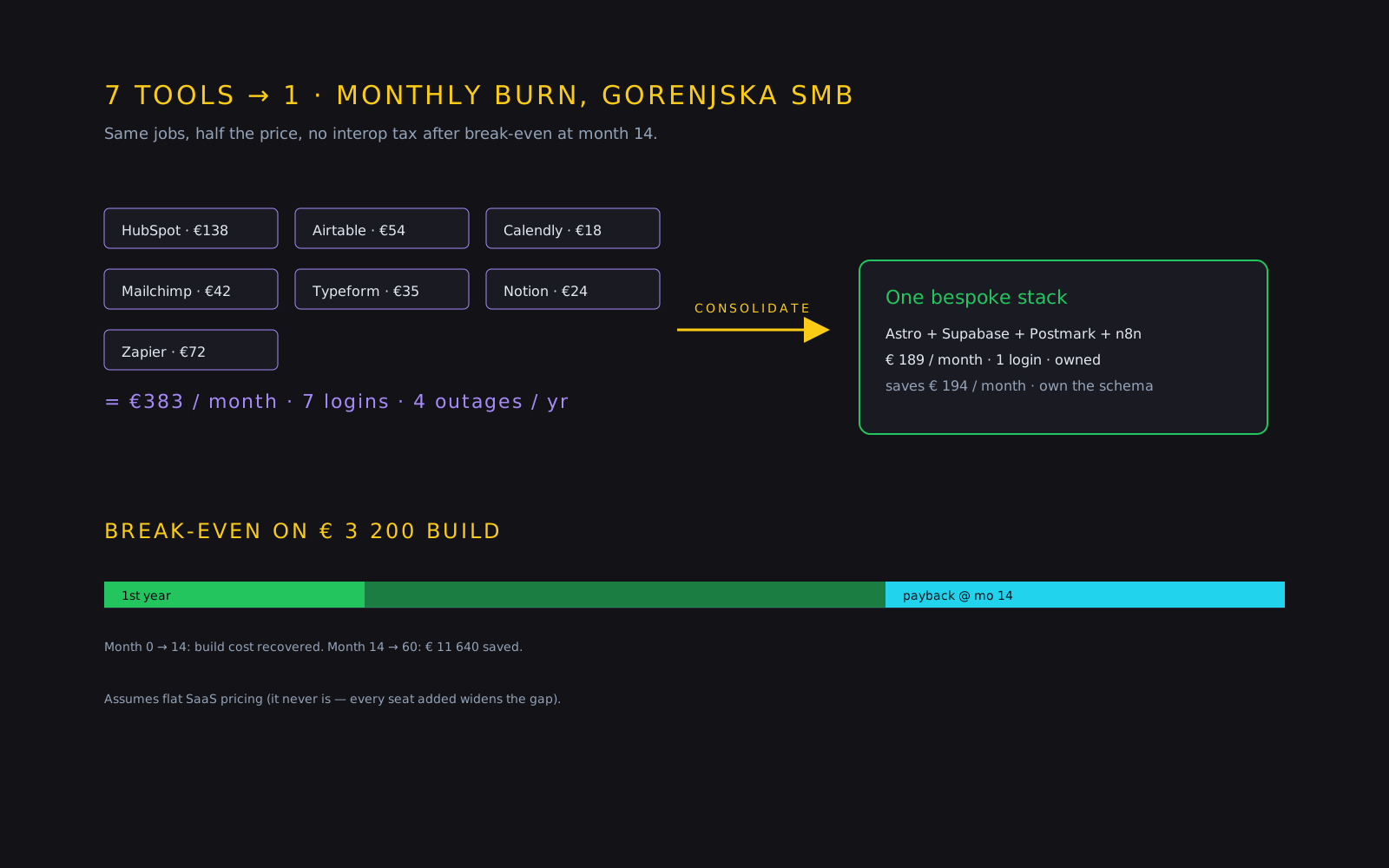
Take a typical Slovenian SMB, the kind we see twice a week. Eight employees, most not spending their whole day in the CRM but touching it. Current state:
- Salesforce Starter, 8 seats: €200/month
- HubSpot Starter for marketing: €180/month
- Notion Plus, 6 users: €60/month
- Airtable Pro for operations: €160/month
- Zoho One for 3 back-office: €135/month
- Zapier Starter for glue automations: €19.99/month
- Total: €754/month = €9,048/year
That’s SaaS only. No accounting software, no Google Workspace, no Slack. Just the tools that overlap with each other by 70% of features.
Now scenario B. Custom lead pipeline + task board + internal dashboard, integrated with Pantheon accounting and Gmail. Discovery: €1,200. MVP: 5 weeks of dev, €7,300. Hosting: Hetzner CX32 with PostgreSQL, backups, monitoring: €95/month.
- One-time: €8,500
- Monthly: €95 (hosting) + €180 (maintenance, first 6 months)
Break-even: month 10. After two years: several thousand ahead. After three: comfortably five figures. None of that depends on Salesforce hiking prices — if they raise another 15% in 2027 (and they will, because they always do), break-even shortens to month 8.
Counter-argument I hear: “But SaaS ships new features every month.” True. Question: how many of those features do you actually use? If the answer is “one every six months, and nobody notices”, the argument is thin.
Where custom still loses
Let’s be clear. Custom does not beat everything. Some categories are so specialized, so standardized, or so regulated that it would be foolish to try:
- Payments — Stripe, PayPal, NLB Klik integration. Never build your own. PCI compliance is hell. Fraud detection is impossible without years of data.
- Transactional email — Postmark, Resend, Mailgun. IP reputation takes years to earn. A custom mail server is a guarantee your messages never reach the inbox.
- Auth — Auth0, Clerk, or for Slovenian bank auth the NLB smsPASS API. Custom auth is wrong. Always.
- Video calls — Zoom, Google Meet. Don’t try.
- General office — Google Workspace, Microsoft 365. Email, calendar, docs. Nobody in the history of software has beaten either.
For those categories, pay the subscription without guilt. They’re cheap relative to what custom would cost, and the market has optimized them better than your developer ever could.
Where custom now wins
Now the other page. Where the math genuinely turns:
- CRMs tuned to your actual sales flow — not the other way round
- Project management following your team’s real workflow, not “a kanban for every occasion”
- Internal analytics dashboards that pull numbers from three of your systems at once
- Quote builders with your actual pricing logic and discount rules
- Invoice, estimate, and offer generators with real branding and accounting impact
- Narrow industry tools: accommodation booking, gym scheduling, mechanic shop workflow, medical appointment tracking
A concrete Gorenjska pattern: a boutique hotel replacing a stack of glued-together tools — a Trivago-style booking widget at roughly a hundred a month, Airtable Pro for room data, WhatsApp Business for guest comms, Zapier holding it all together — with a single custom stack: booking calendar, room inventory, guest-message pipeline, automatic accounting sync. Low-four-figure one-time build plus hosting in the low tens per month. Bookings that used to take seven clicks now take one. Timeline: about ten weeks end-to-end. Better than SaaS not because it’s cheaper, but because it fits the actual work, rather than the actual work fitting it.
The trap: building everything custom
Now a serious warning. Anyone who reads the first half and runs a spreadsheet calculating “how much can I save if I build everything myself” is making a mistake.
The rule is: look at the 2–3 subscriptions where you pay most and use least. Not the ones you use 90% of. Not Google Workspace. Not Stripe. The ones where you pay €200 a month for four features and use one.
Three signs a SaaS is a candidate for replacement:
- Annual cost exceeds €2,000
- You use less than a third of the features
- Nobody on your team has ever said “this tool makes my life better”
If all three are true — probably a candidate. If any one fails — leave it.
Tip: rule of thumb — if you pay more than €500/month for one tool and use less than 30% of its features, custom is worth costing out. Below €500/month or above 30% usage, stay put. The discovery is a fixed price either way.
What a good “personalized SaaS” project looks like
Our typical shape for a mid-size SMB:
- Week 1: Discovery. Sit with the team, watch the actual workflow, not the one the manager wrote in Notion. Nail down 12–20 functional requirements, split must-have from nice-to-have. Output: a PDF with spec, price, timeline. Cost: €800–1,500.
- Weeks 2–7: MVP. Four to six weeks of build. No hiding progress — a demo every five days. We use AI-assisted dev tools because they’re faster and, honestly, they’re built for exactly this kind of internal tooling.
- Weeks 8–9: Soft-launch. Two or three power users start working in the new system. The old SaaS keeps running in parallel. We log everything that pokes out.
- Weeks 10–12: Iteration. Fix what poked out. Fold in the narrow set of nice-to-haves that turned out to matter more than expected in soft-launch. Freeze scope.
- Cutover. The old SaaS is cancelled. Data is migrated. The maintenance contract kicks in.
Total: 10–12 weeks, €8,000–15,000. Maintenance after the first year: €150–350/month. A custom system after two years is no less reliable than the SaaS you were on — provided it was built decently.
Who this is NOT for
Three cases where our advice is: stay on SaaS.
- Pre-product SMB. If you’re still looking for product-market fit and don’t know whether your process will survive, don’t build custom. Use Notion and Airtable until the thing stabilizes.
- Solo founder. If you’re one person with a €50/month SaaS bill, do not commission a €10,000 custom system. Break-even lands in year 17.
- Companies where the SaaS bill is under €500/month. The math isn’t on your side. Discovery and MVP eat the three-year saving. Wait until subscriptions grow.
Why most SMBs haven’t caught on
Because the build-vs-buy debate closed in 2018, and nobody re-checked. Because AI-assisted dev tools were still bad for real production code in 2023, moderate in 2024, and only in 2025–2026 became good enough that an experienced developer with them can build a custom internal system in a third of the time. The decision cycle inside SMBs is slower than the cycle of technology. So: the math flipped in January 2025, but the average Slovenian company will notice around 2027.
The earlier you decide, the more you save.
FAQ
How does AI-assisted development actually cut cost? Not by writing entire code instead of the developer — that still doesn’t work reliably. But by shortening time on boilerplate, migrations, tests, types, docs, refactors. Our developer, who could produce eight hours of productive work per day in 2022, now produces roughly three times more code in the same eight hours that survives code review. Price to the client follows.
What if my needs change — is custom flexible? More than SaaS. A custom system can change in three days if it was architected reasonably. SaaS can change however much the vendor lets you — which is usually nothing. Caveat: custom built by someone who doesn’t think long-term is less flexible than SaaS. Ask who’s building it.
Isn’t this reverse vendor lock-in — I’m tied to the studio that built it? Partly. But the code is yours. The repo is yours. The database is yours. If the studio walks away, another developer takes over in two weeks, assuming the code is decent and documented. Put that in the contract. With SaaS, when the vendor leaves or raises prices, you have exactly one option: cancel and migrate to something else.
How much does maintenance cost? First 6 months: €150–350/month for a typical mid-size SMB system. Includes bug fixes, small additions, dependency updates, monitoring. After the first year, once the system settles: €80–200/month. One larger “refresh” per year at €1,500–3,000 that goes into new features.
What if the studio goes out of business? That’s exactly why your code lives in your git repo, on your account (GitHub Organization, GitLab Group). Why multiple people have access. Why the docs are enough for another developer to understand what’s going on. And why we use mainstream tech (Node.js, PostgreSQL, React), not exotic choices where replacements are impossible to find.
Can I run it on my own server? Yes. Docker container, PostgreSQL, one Node.js app. If you have a server in the office or a colo, it runs there. If not, Hetzner Germany is the cheapest European option — €25–80/month, GDPR-friendly, EU-located.
Does this work for stores or is it only for internal tools? Mainly internal tools, where the math is clearest. For a Slovenian e-commerce store, WooCommerce or Shopify is still a good choice — that’s where SaaS genuinely wins, because payments, shipping, and catalog are standardized enough that custom makes no sense. Custom in commerce pays off only for niche cases: bookings, configurators, B2B catalogs with complex pricing logic.
How do I decide which SaaS to replace first? Question 1: which one costs me most per year. Question 2: which one uses the smallest fraction of features. Question 3: which one hurts most — where does my team hand-carry data between it and another system. Where all three overlap, start there.
If paying two hundred euros a month for a quarter of a tool’s features nags at you, we should talk. At Numen we build point-solution custom systems for Slovenian SMBs — discovery is a fixed price, no hidden costs, no vendor lock-in. The code is yours from day one.

